

Locked RH850 MCU programming from Toyota Harrier and Venza Speedometer by dash plugs without any soldering
Hey! Today on the bench we have one of the most modern Toyota units we've worked on: the full-digital Denso instrument cluster from the Toyota Harrier. It's a single 12.3" screen with two blue-ringed gauges, a large digital speed readout in the middle, and a 180 km/h scale. Ours is a Japanese-market unit, so every message on the centre display comes up in Japanese.
To be straight with you: this is one of the best programs we have in FORZA 614. The first time you power one on your desk, the centre display may show a Japanese warning: Pre-Crash Safety malfunction - have the vehicle inspected at your dealer. That's not a fault in the cluster. On the bench there's no radar module on the bus, so the dash reports the missing system. If you see it, don't let it worry you or your customer.
Below you'll find what's inside the dash, why these clusters so often end up with a dark screen, and how to read, write and reset them diagnostically. No soldering iron needed.
Toyota Harrier Instrument Cluster programming with FORZA 614
What's inside the Toyota Harrier Denso cluster
This is not a classic "MCU + serial EEPROM" board. The Harrier dashboard works more like a small computer. A Renesas RH850 controller handles the vehicle side (CAN, odometer, configuration), and a separate graphics processor with its own RAM and eMMC storage renders everything you see on the screen. Odometer and configuration data live inside the RH850 itself, in its data flash. There's no external 24Cxx or 93Cxx chip to pull.
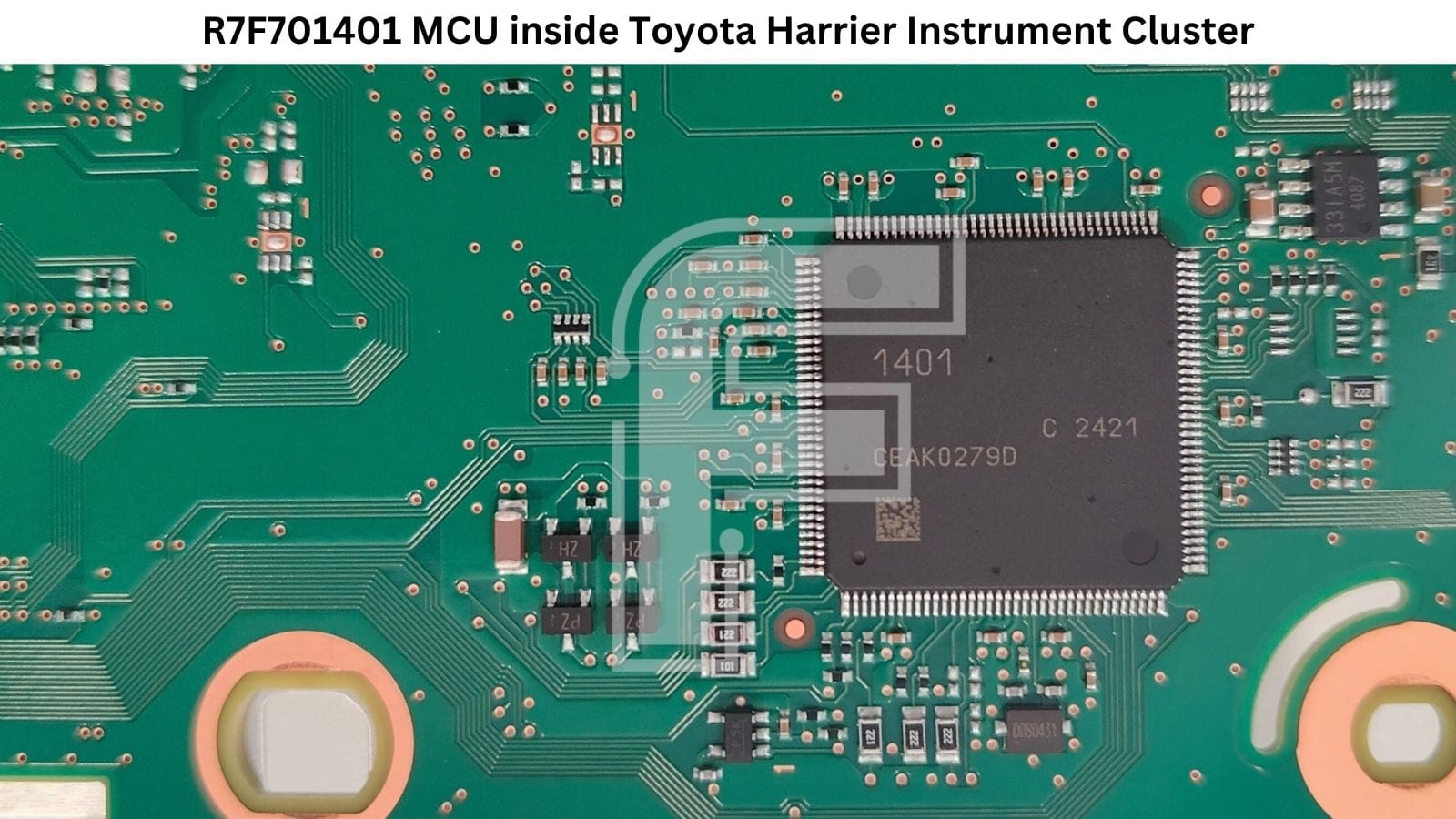
- Main microcontroller: Renesas R7F701401 (RH850/D1L family, 144-pin LQFP) marked on the package only as 1401, along with lot codes like C 2421 and CEAK0279D. The chip is locked. It handles CAN communication and gauge logic and stores the odometer and configuration in its internal data flash (the RH850's "EEPROM").
- Graphics processor: large BGA chip under thermal compound - a dedicated graphics processor that drives the 12.3" display, working together with its own DRAM and eMMC memory.
- Power management IC: ROHM BD9573MUF-M - an automotive PMIC that supplies and sequences the power rails for the graphics side of the board.
- eMMC storage: Samsung KLM8G1CEUF (SEC 413 B04Q) - 8 GB automotive eMMC. It holds the graphics software and screen assets.
- DRAM: 2× Micron, FBGA code D9SHM (marking 4MP17) - working memory for the graphics processor.
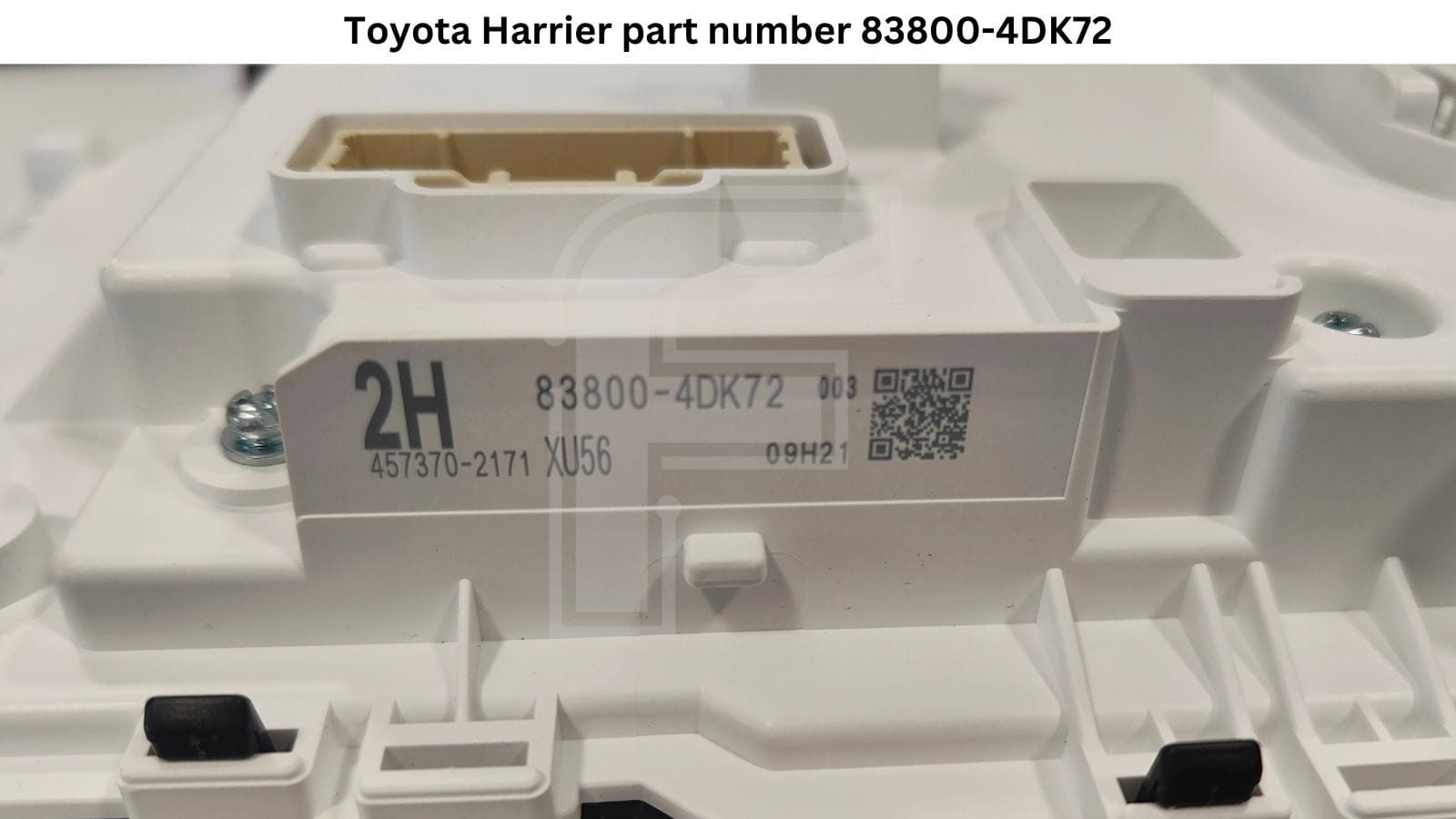
- Identification labels: Toyota part number 83800-4DK72, Denso number 457370-2171.
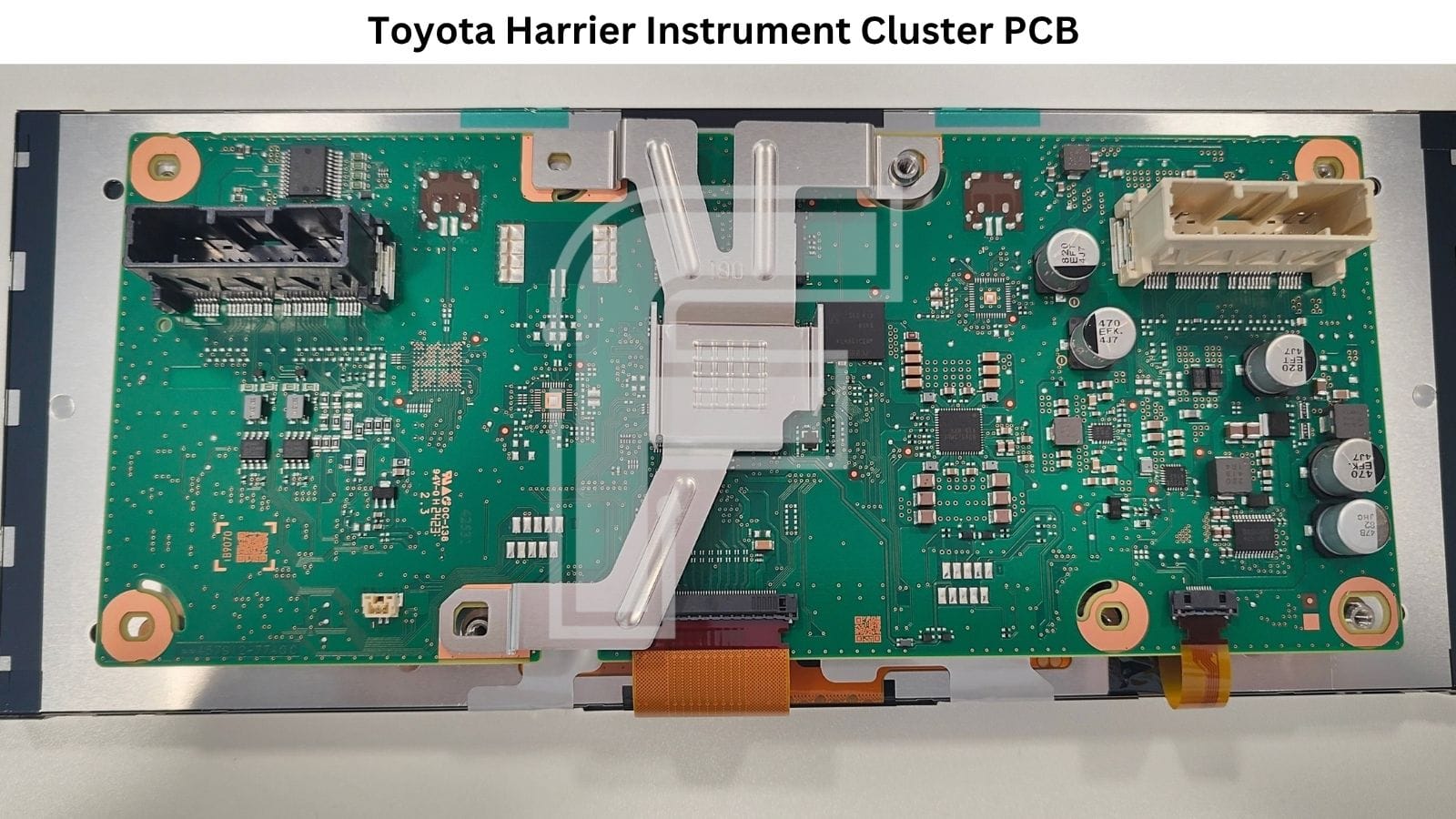
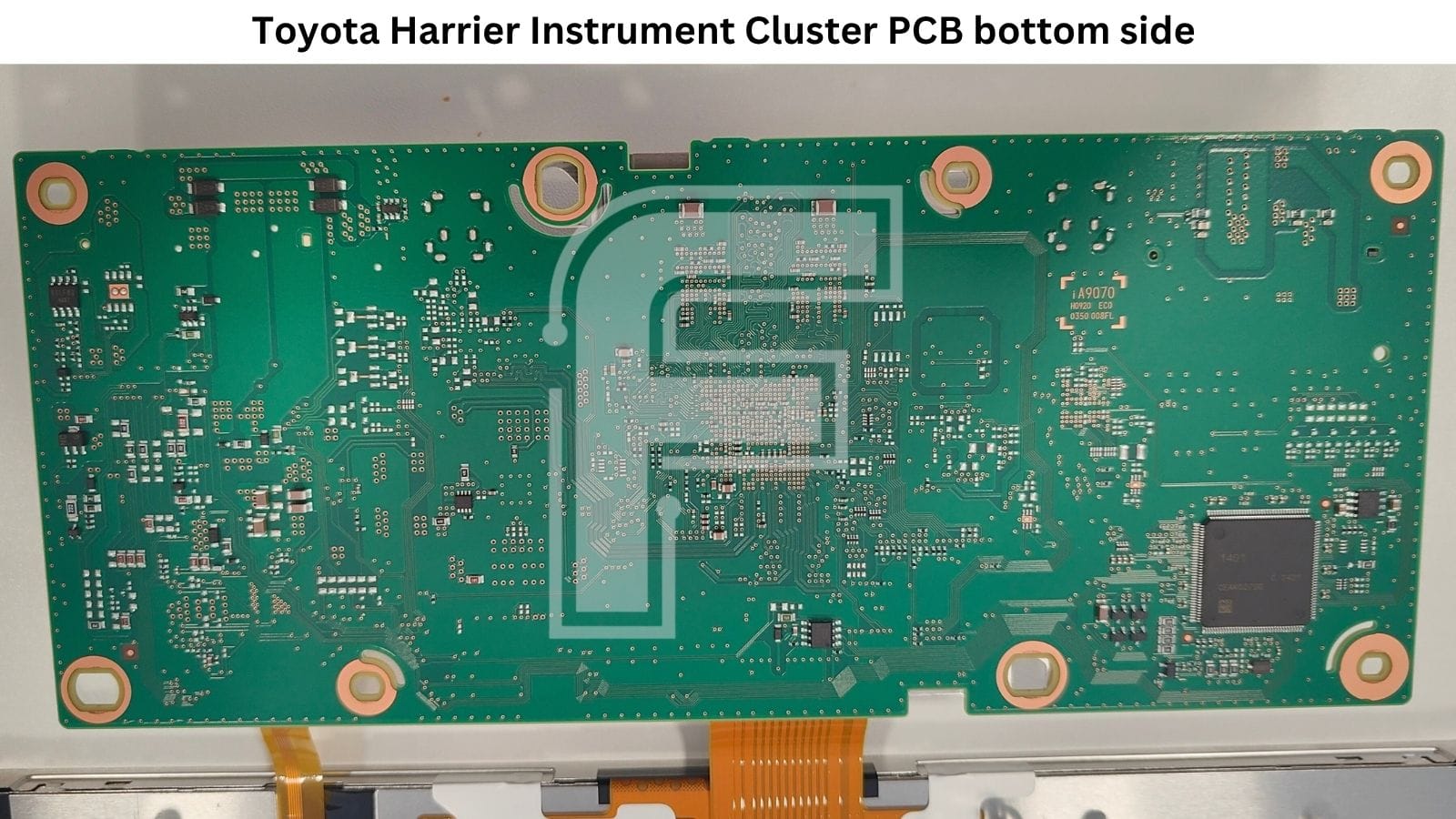
The board is double-sided and sits under a metal stiffener. You'll find two board-level connectors: a black one at the top and a white one at the bottom. Remember both - they matter in the connection section.
LPM123G406A 12.3" display LCD in Toyota Clusters
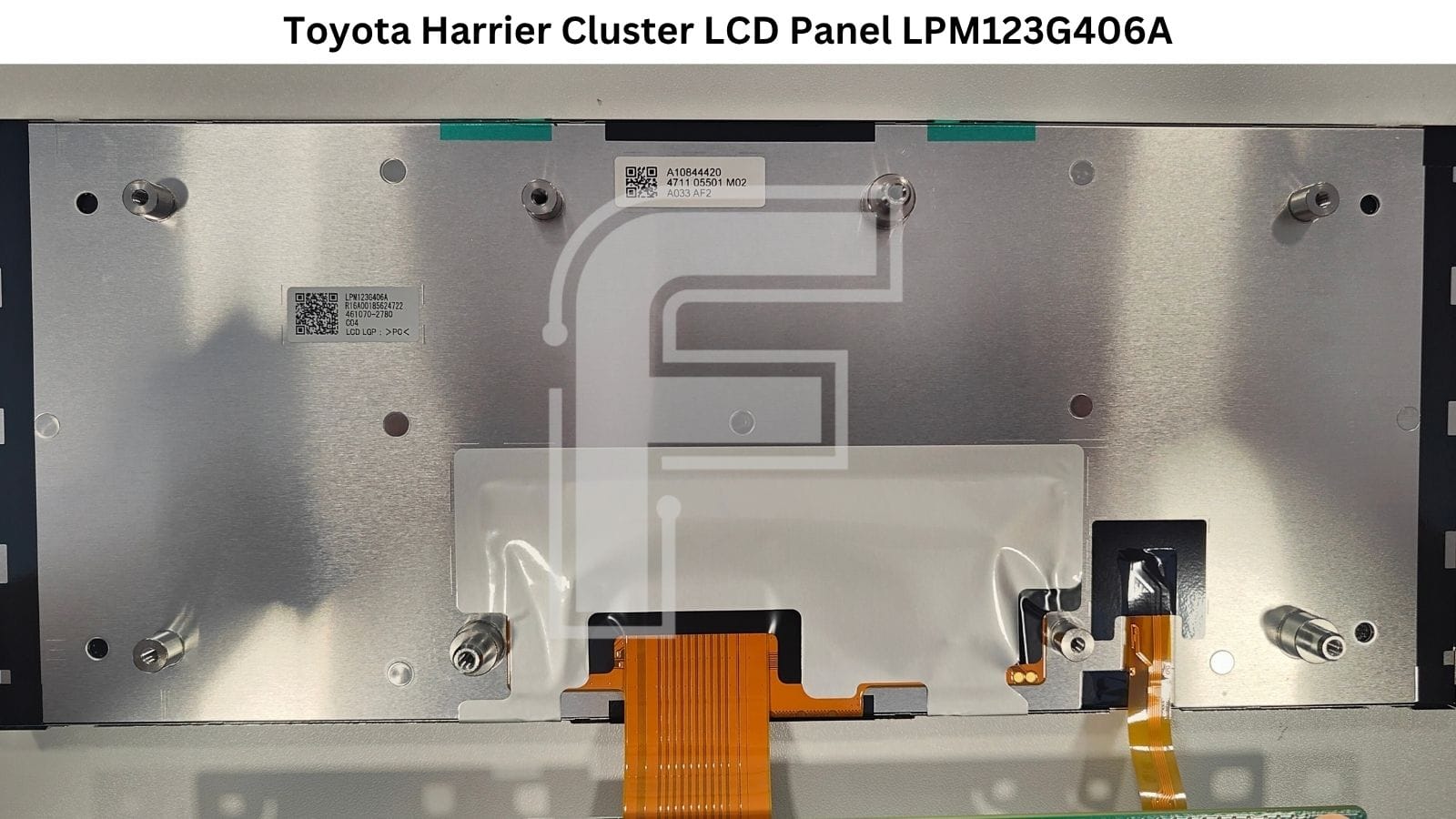
The display in the Harrier cluster is the 12.3" colour TFT LPM123G406A. The panel label also carries Denso number 461070-2780 (revision C04). The whole cluster face, including both gauges, is graphics on this one panel.
What's worth knowing: when a Harrier cluster arrives at your workshop with a black screen, the panel is usually not the culprit. In most cases we see, the LPM123G406A is fine and the problem is on the PCB and in the data in the board's flash memories. Before you order a display, check the board.
Common faults – the "dark screen"
- Dark / black screen. This is the most common problem with the newest Toyota digital clusters. Something went wrong at the production or engineering stage, and many units go dark with no warning. As mentioned above, the cause usually sits on the board and in the flash memory data, not in the panel.
- Communication usually still works on a dark cluster. This is the key point for repairs. Even when the screen shows nothing, in most cases FORZA 614 still connects to the R7F701401 and reads its data flash. You don't need to see anything on the display to save the customer's data.
Denso or Yazaki? Check the label before you start
Toyota buys digital clusters from more than one supplier, and the difference matters:
- Denso clusters (like this Harrier) keep their data in the data flash of the RH850 R7F701401. They are supported by FORZA 614 diagnostically.
- Yazaki clusters in modern Toyotas use an external MSOP EEPROM, 93C66 or 93C86. These clusters are not supported diagnostically by FORZA 614 or by any other tool on the market. For reset settings or odometer you must play with external eeprom.
What about the Toyota Venza?
In North America, the current-generation Harrier is sold as the Toyota Venza. That means everything in this article - the R7F701401 data flash, the dark-screen data transfer, the 0 km reset and the F8 connection should apply to Venza clusters made by Denso as well. Just check the rear label first: if your Venza cluster turns out to be a Yazaki unit, the section above applies instead.
FORZA 614 software programming options for Toyota Harrier dashboard
With FORZA 614 you read and write the data flash of the R7F701401 - the RH850's internal EEPROM area that holds the odometer and configuration. The file you get is not encrypted - we built FORZA 614 for your convenience, so the data comes out in a form you can work with right away. That makes it directly usable for practical work:
- Cluster replacement (donor swap). Read the data from the original cluster and write it to a spare, working unit. This works even when the original's screen is completely dark, because communication usually survives.
- Toyota Metric conversion. An unencrypted data file makes km/miles conversions much easier. You do need to know which part of the data controls the regional settings, though: the km or miles units, and the brake warning indicator, which shows "BRAKE" text in some markets and the (!) symbol in others.
- Odometer reset to 0 km. For dead Toyota clusters this is a standard step in the repair process. More below.
ℹ️ Diagnostic read and write - both supported. FORZA 614 reads and writes the full R7F701401 data flash diagnostically, through the dash plugs. You don't need to desolder components, remove capacitors from the board, or lift MCU pins, as you would with direct programmers. The method is 100% safe for Denso clusters.
ℹ️ If the cluster was previously handled with a direct RH850 programmer. Some direct programmers for RH850 read and write the data in encrypted form, and some also modify certain data blocks. After that, the diagnostic programming method may stop working on that cluster. If FORZA 614 can't read or write a Harrier cluster, consider this as the most likely reason.
Odometer reset – why spare parts shops do it
When a Toyota cluster dies, resetting the odometer is a standard part of the procedure. For shops selling used clusters it's a clear advantage: a cluster set to 0 km sells better, and adapting it to the car usually goes more smoothly with various diagnostic testers. A shop can also set the exact value the customer requires before shipping, so the cluster goes into the car ready to use.
Toyota Harrier dashboard pinout and connection - F8 cable
The Harrier gets a dedicated F8 cable in the FORZA 614 kit. As usual, you connect it to FORZA 614 through the F1 main adapter. The F8 cable has two plugs: one goes into the black cluster connector, the other into the white one. They're keyed differently, so you can't mix them up. Plug in and you're ready to work.
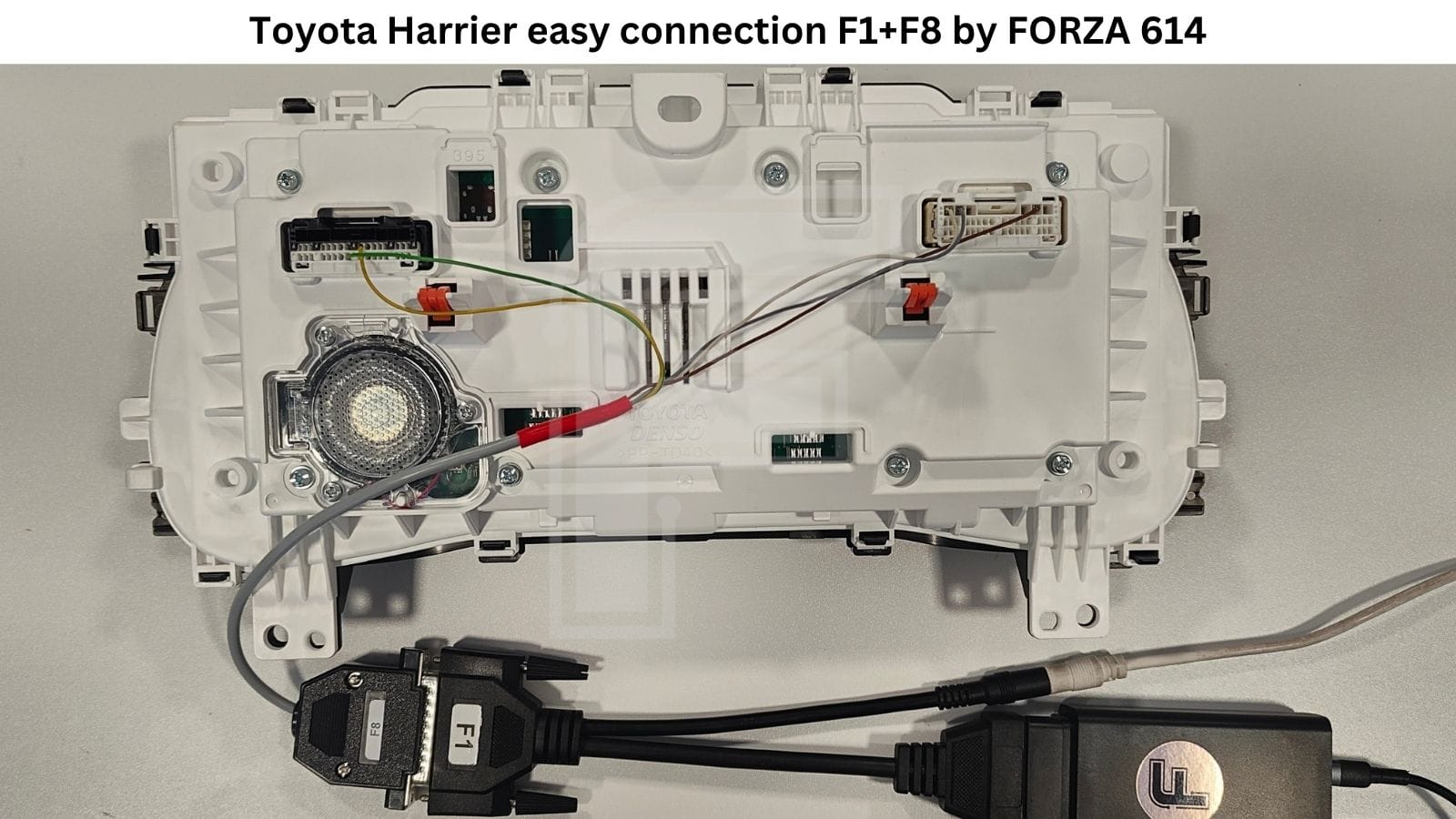
We recommend working on the bench, through the dash plugs. In the newest Toyotas, diagnostic programming over OBD2 will most likely be blocked. So take the cluster out of the car and work on your desk. With the F8 cable you can't get the connection wrong. It's convenient and safe for the cluster, and it saves you time on every job.
Where the Harrier cluster earns money for your workshop
New Toyota digital clusters go dark often, and a new unit from the dealer is expensive. That opens two simple revenue streams for you:
- Dark-screen repairs and swaps. The customer brings a dead cluster. You read the data from the original, write it to a working spare, and the car leaves with its own mileage and configuration. You don't hand the job back to the dealer.
- Preparing used clusters. If you supply spare parts shops (or run one yourself), resetting to 0 km or setting the exact required value is a service you sell on every Harrier unit going through your workshop.
All of it on one bench, with one cable, no soldering station, and no risk of damaging the board.
One simple subscription
FORZA 614 runs on a flat monthly subscription. There are no individual licences, no per-car tokens and no extra fees for single functions. You refresh the activation and work. The subscription also means a lower upfront cost and constant development: new clusters like this Harrier are added in regular updates.
FAQ
Can I read a Toyota Harrier cluster with a black screen?
In most cases, yes. A dark screen usually doesn't mean lost communication, so FORZA 614 still reads the R7F701401 data flash, and you can write that data to a spare cluster.
Which MCU is in the Toyota Harrier Denso cluster?
The main microcontroller is the Renesas R7F701401 (RH850/D1L), marked on the package only as "1401". The odometer and configuration are stored in its internal data flash.
Do I need to solder or lift MCU pins?
No. FORZA 614 works diagnostically through the dash plugs and the dedicated F8 cable. No soldering, no removing capacitors, no lifting pins.
Is the data flash file encrypted?
No. The file FORZA 614 reads from the Harrier cluster is unencrypted, which makes it useful for donor swaps and metric conversions.
Does FORZA 614 support Toyota clusters made by Yazaki?
No. Yazaki-made Toyota clusters use an external 93C66 or 93C86 EEPROM and can't be programmed diagnostically by FORZA 614 or any other tool.
Can I program the cluster through OBD2?
We recommend the bench and dash plugs. In the newest Toyotas, programming over OBD2 will most likely be blocked.


